
October 3, 2026
Chess Pieces: Names, Values, Moves, and How They Work
Chess is played with six different types of pieces, each with its own movement, value, and purpose. Understanding how these chess pieces move and work together is one of the first steps toward becoming a better player. While some pieces can move across the entire board, others are more restricted, and each has a role in controlling squares, capturing opponents, and protecting the king. Whether you're learning chess for the first time or looking to improve your game, this guide explains all six chess pieces, their names, values, movements, and how to use them effectively.
What Are the 6 Chess Pieces?
A standard chess game starts with 32 pieces, 16 for each player. Each player has one king, one queen, two rooks, two bishops, two knights, and eight pawns. Although all pieces contribute to the game, they have different abilities and levels of importance.











The standard starting position of all 32 chess pieces. White begins at the bottom and Black at the top.
Here are the six types of chess pieces:
King: The most important piece. The game is lost if your king is checkmated.
Queen: The most powerful piece, combining the movement of a rook and a bishop.
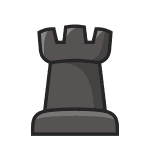
Rook: A powerful piece that moves horizontally and vertically.
Bishop: A long-range piece that moves diagonally.
Knight: A unique piece that moves in an L-shape and can jump over other pieces.
Pawn: The most numerous piece, which moves forward and captures diagonally.
1. The King
The king is the most important chess piece because the main objective of the game is to checkmate your opponent's king while keeping your own king safe. Unlike the queen or rook, the king has limited movement and can move only one square in any direction, as long as the destination square is not attacked by an opponent's piece.
The black king on d5 can move one square in any direction to the highlighted squares, provided they are not under attack.
The king can move horizontally, vertically, or diagonally, but it can never move onto a square controlled by an enemy piece. If the king is under attack, it is said to be in check, and the player must make a legal move to remove that threat.
The king also has a special move called castling, which involves moving the king two squares toward a rook and placing that rook on the square the king crosses. Castling is only allowed when specific conditions are met, including that neither piece has previously moved and the king does not move through or into check.
King's value: The king has no standard numerical point value because it cannot be traded or captured. Its survival determines the outcome of the game.
How to use the king: During the opening and middlegame, prioritize keeping your king safe, usually by castling. In the endgame, when fewer pieces remain on the board, the king becomes an active piece that can help support pawns, control important squares, and attack opposing pieces.
2. The Queen
The queen is the most powerful piece in chess because it combines the movement of a rook and a bishop. It can move any number of squares horizontally, vertically, or diagonally, provided there are no pieces blocking its path.
The queen on d5 can move in all straight and diagonal directions, as far as the board and other pieces allow.
The queen can control many squares at once, making it especially useful for attacking, defending, and creating threats. It is often used to coordinate attacks with other pieces, particularly when the opponent's king is exposed.
However, beginners often make the mistake of bringing their queen out too early. Since the queen is so powerful, opponents can develop their pieces while attacking it, forcing it to move repeatedly and losing valuable time.
Queen's value: 9 points.
How to use the queen: Develop your queen when it can support a clear plan, such as controlling an open file, attacking a weak pawn, or coordinating with other pieces. Avoid exposing it to unnecessary attacks, and remember that even the strongest piece needs support.
3. The Rook
The rook is a powerful chess piece that moves horizontally and vertically across the board. It can travel any number of empty squares in a straight line but cannot move diagonally or jump over other pieces.
The rook on d5 can move along the d-file and the fifth rank, provided no pieces block its path.
Rooks are particularly effective on open files, which are columns without pawns. When two rooks work together on the same file or rank, they can create significant pressure on the opponent's position.
Rooks also have an important role in castling. During this special move, the rook shifts toward the center, helping connect the rooks and improve king safety.
Rook's value: 5 points.
How to use the rook: Try to place your rooks on open or semi-open files where they can control important squares and attack weaknesses. Rooks are often especially powerful in the endgame because they can support passed pawns and restrict the opponent's king.
4. The Bishop
The bishop is a long-range chess piece that moves diagonally in any direction. It can move any number of empty squares along a diagonal but cannot jump over other pieces.
The bishop on d5 controls diagonals in four directions, but it can only move along squares of its original color.
Each player starts with two bishops. One moves on light-colored squares, while the other moves on dark-colored squares. A bishop can never change the color of the squares it controls during a game.
Bishops are particularly strong in open positions where there are fewer pawns blocking their diagonals. They can attack pieces from a distance and control important areas of the board without needing to move close to the opponent.
Bishop's value: 3 points.
How to use the bishop: Develop your bishops toward active diagonals where they can influence the center or target weaknesses in your opponent's position. Avoid trapping your bishops behind your own pawns, especially when an open diagonal could give them greater activity.
5. The Knight
The knight is one of the most unique chess pieces because it moves in an L-shape and is the only piece that can jump over other pieces. It moves two squares in one direction and then one square perpendicular to that direction.
The knight on d5 can move to any of the eight highlighted squares, regardless of pieces standing in between.
Unlike bishops, rooks, and queens, knights are not restricted by pieces blocking their path. This makes them especially useful in crowded positions where other pieces may have limited movement.
Knights are also particularly effective when placed in the center of the board, where they can control up to eight squares. A knight near the edge of the board usually has fewer available squares, which is why players often use the phrase "a knight on the rim is dim."
Knight's value: 3 points.
How to use the knight: Develop your knights toward central squares where they can control more of the board and create tactical opportunities. Look for forks, where a knight attacks two or more enemy pieces at once, and use its ability to jump over pieces to create unexpected threats.
6. The Pawn
The pawn is the most common and least valuable chess piece, but that does not mean it is unimportant. Each player starts with eight pawns, which help control the center, protect other pieces, and create opportunities for promotion.
Pawns move forward one square at a time, but on their very first move, they may advance two squares if both squares are empty. Unlike other pieces, pawns capture diagonally, one square forward to the left or right.
The white pawn on e4 can capture the black pawn on d5 diagonally, but cannot capture a piece directly in front of it.
Pawns also have two special rules: en passant and promotion. En passant allows a pawn to capture an opposing pawn that has just advanced two squares, under specific conditions. Promotion happens when a pawn reaches the opposite end of the board, allowing it to become a queen, rook, bishop, or knight of the same color.
Pawn's value: 1 point.
How to use the pawn: Use pawns to control central squares, support your pieces, and create a strong pawn structure. Think carefully before advancing them because pawns cannot move backward, and every pawn move can permanently change the squares your pieces can control or defend.
Chess Piece Values: How Much Is Each Piece Worth?
Each chess piece has an approximate point value that helps players understand whether a trade is beneficial. These values are not official rules, but they are widely used as a guide when evaluating positions.
| Chess piece | Point value |
| ----------- | ----------: |
| Pawn | 1 |
| Knight | 3 |
| Bishop | 3 |
| Rook | 5 |
| Queen | 9 |
| King | Priceless |
These values are useful for beginners when deciding whether to exchange pieces. For example, trading a rook worth approximately 5 points for a knight worth approximately 3 points usually means losing material, unless there is a positional or tactical reason for doing so.
However, piece values are not fixed in every position. A knight may be more useful than a bishop in a closed position, while a bishop can be especially powerful on open diagonals. The value of a piece depends on how effectively it can contribute to the game.
Which Chess Pieces Are the Most Powerful?
The queen is generally the most powerful chess piece because of its ability to move in multiple directions over long distances. However, the king is the most important piece because losing it to checkmate ends the game.
Rooks are also powerful because of their ability to control open files and ranks, while bishops and knights provide valuable support and tactical opportunities. Pawns may have the lowest individual point value, but a well-coordinated group of pawns can control the center, restrict enemy pieces, and create promotion threats.
Rather than focusing only on which piece is strongest, it is more useful to understand how each piece works with the others. A coordinated group of pieces can often be much more effective than a powerful piece operating alone.
Common Mistakes Beginners Make With Chess Pieces
Learning how each piece moves is only the beginning. Beginners often make mistakes when using their pieces during actual games.
Leaving pieces undefended. Moving a piece to an active square without checking whether your opponent can capture it can lead to unnecessary material loss.
Bringing the queen out too early. An early queen attack can give your opponent opportunities to develop pieces while gaining time by attacking your queen.
Keeping knights on the edge. Knights usually control fewer squares near the edges and corners, so central squares are often more useful.
Trapping your bishops. Placing pawns on squares that block your bishops can limit their activity and reduce their influence.
Ignoring rook activity. Rooks are often left on their starting squares for too long instead of being placed on open files where they can influence the game.
Advancing pawns without a plan. Since pawns cannot move backward, careless advances can create weaknesses that are difficult to repair.
A useful habit is to check what your opponent's last move attacks before deciding how to move your own pieces. This simple practice can help prevent many avoidable blunders.
How to Improve Your Use of Chess Pieces
Understanding the movement and value of each chess piece is essential, but becoming a better player requires learning how to coordinate them effectively. Practice developing your pieces toward useful squares, protecting them from attacks, and looking for opportunities to work together.
Playing complete games is one of the most practical ways to develop these skills. After each game, review any pieces you lost and consider whether they could have been protected or placed on better squares.
You can practice against Chessora to become more familiar with how different pieces interact, experiment with different strategies, and gradually improve your decision-making. Start with easier difficulty levels if you're a beginner, then increase the challenge as you become more confident.